
Problem-Solving Session Using the FOCUS-PDCA Method
A practical professional training course that develops structured problem-solving skills using the FOCUS-PDCA methodology. Participants learn how to identify problems, understand processes, investigate root causes, develop corrective actions, implement improvements, monitor results, and sustain measurable performance gains.
Why is this course included in American Board pathways?
This course is appropriate for professionals who need a practical and repeatable method for investigating organizational problems and implementing measurable improvements. It combines FOCUS-PDCA with root-cause analysis, corrective action, performance measurement, implementation, and sustainability, making it applicable across quality, healthcare, operations, and administrative environments.
Trust summary
- Clearly stated duration: 8 Hours hours.
- Delivery mode: Online.
Search intents covered by this course
How should you choose this course?
Choose this course when you need practical understanding, clear professional requirements, and a structured learning path instead of fragmented information.
When is this type of training useful?
It is useful when entering the field, developing your professional role, or preparing a team that needs a shared understanding of standards and practical steps.
Supporting links and resources
A practical professional training course that develops structured problem-solving skills using the FOCUS-PDCA methodology. Participants learn how to identify problems, understand processes, investigate root causes, develop corrective actions, implement improvements, monitor results, and sustain measurable performance gains.
Quick answers about Problem-Solving Session Using the FOCUS-PDCA Method
Is this course suitable for beginners?
Yes. The course is suitable for professionals with limited formal problem-solving or quality-improvement training. Basic understanding of workplace processes is beneficial but advanced quality-management experience is not required.
Other common names: FOCUS-PDCA Training Course، FOCUS PDCA Problem-Solving Course، FOCUS-PDCA Method Training، Problem-Solving Using FOCUS-PDCA، FOCUS-PDCA Quality Improvement Course، PDCA Problem-Solving Training، FOCUS Methodology Training Course، Continuous Improvement Using FOCUS-PDCA، Structured Problem-Solving Course، Quality Problem-Solving Training
About Problem-Solving Session Using the FOCUS-PDCA Method
The Problem-Solving Session Using the FOCUS-PDCA Method provides a structured and practical approach to identifying, analyzing, solving, and preventing recurring organizational problems. FOCUS-PDCA combines a systematic problem-identification process with the Plan-Do-Check-Act improvement cycle, giving professionals a disciplined framework for moving from an identified performance gap to sustainable improvement. The methodology is particularly useful in quality management, healthcare, operations, administration, customer service, and other environments where reliable processes and continuous improvement are important.
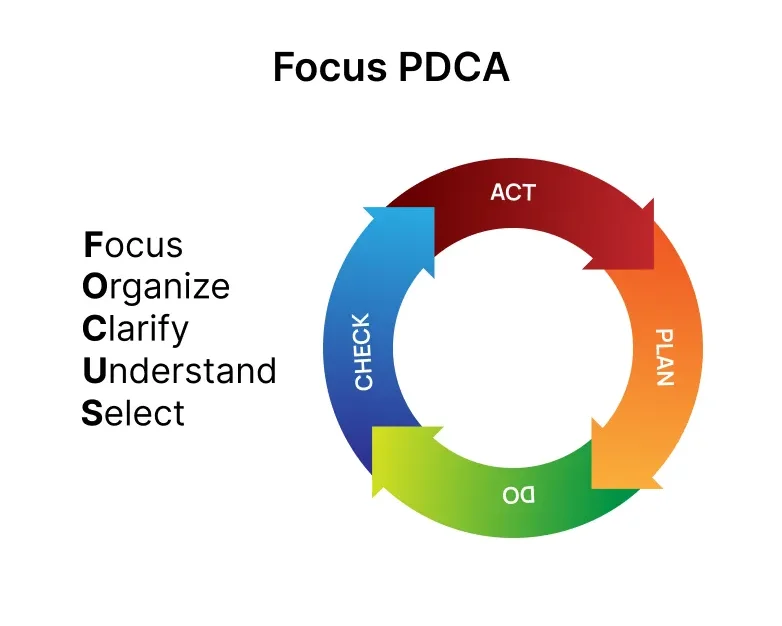
The program begins with the FOCUS stage, helping participants understand how to Find a process or problem that requires improvement, Organize a team capable of addressing it, Clarify the current process and performance gap, Understand the causes and contributing factors, and Select an appropriate improvement strategy. Participants will learn how to distinguish symptoms from underlying problems and how to establish a clear problem statement before attempting to implement solutions.
The course then connects the FOCUS methodology with PDCA. Participants will explore how to Plan an improvement based on evidence, Do the proposed intervention on an appropriate scale, Check the results against defined measures, and Act by standardizing successful changes or adjusting the approach when results do not meet expectations. This creates a continuous improvement loop rather than treating problem-solving as a one-time corrective exercise.
Root-cause analysis is a major component of the training. Participants will examine practical techniques such as the Five Whys, cause-and-effect analysis, process mapping, brainstorming, Pareto analysis, and basic data review. The course emphasizes evidence-based investigation and encourages participants to avoid premature conclusions, blame-based approaches, or solutions that address symptoms without resolving the underlying process issue.
Participants will also develop skills in action planning, measurement, team collaboration, and change implementation. The program explains how to establish improvement objectives, assign responsibilities, define timelines, select meaningful indicators, document interventions, and communicate results. Participants will learn how effective problem-solving depends not only on identifying the right solution but also on implementing it consistently and verifying whether it produces the intended improvement.
The final part of the course focuses on sustaining improvements and preventing recurrence. Participants will explore standardization, monitoring, documentation, follow-up, corrective action, preventive thinking, and continuous improvement. By completing the session, participants will have a practical FOCUS-PDCA framework that can be applied to real organizational problems and used to improve process reliability, quality, efficiency, and performance.
Target audience for Problem-Solving Session Using the FOCUS-PDCA Method
Quality Managers
Quality Professionals
Process Improvement Professionals
Continuous Improvement Specialists
Operations Managers
Department Managers
Team Leaders
Supervisors
Healthcare Quality Professionals
Hospital Administrators
Healthcare Managers
Process Owners
Internal Auditors
Compliance Professionals
Risk Management Professionals
Project Managers
Operations Professionals
Administrative Managers
Customer Service Managers
Business Improvement Professionals
Target countries and study availability
Target countries: Egypt، Saudi Arabia، United Arab Emirates، Kuwait، Qatar، Bahrain، Oman، Jordan، United Kingdom، United States، International Participants
Available online outside Egypt: Yes
The course is designed for international professional development and can be applied across industries. Organizations should adapt improvement activities to applicable quality requirements, regulatory obligations, internal procedures, patient-safety requirements where relevant, and sector-specific standards.
Study details
| Delivery mode | Online |
|---|---|
| Course language | English |
| International pricing note | International pricing is calculated approximately from the local tuition fee and may vary depending on exchange rates, promotional offers, taxes, or payment processing fees. |
| Duration | 8 Hours hours |
| In-person location | General |
| Credential or accreditation body type | Professional Training Certification |
| Training assistant or coordinator | American Board Admissions Team |
| What the price includes | Training sessions. Professional learning materials. Instructor support. Recorded lectures for 12 months (online participants). Professional course certificate. |
| Additional fees | None for online delivery |
| Price | 295 USD |
Why might American Board be a suitable choice for Problem-Solving Session Using the FOCUS-PDCA Method؟
This course is appropriate for professionals who need a practical and repeatable method for investigating organizational problems and implementing measurable improvements. It combines FOCUS-PDCA with root-cause analysis, corrective action, performance measurement, implementation, and sustainability, making it applicable across quality, healthcare, operations, and administrative environments.
Links related to Problem-Solving Session Using the FOCUS-PDCA Method
Supporting articles about Problem-Solving Session Using the FOCUS-PDCA Method
Related questions about Problem-Solving Session Using the FOCUS-PDCA Method
What is the FOCUS-PDCA method?
FOCUS-PDCA is a structured quality-improvement and problem-solving approach that combines the FOCUS process for identifying and understanding improvement opportunities with the PDCA cycle for planning, implementing, checking, and acting on improvements.
What does FOCUS stand for in FOCUS-PDCA?
FOCUS is commonly used as an acronym for Find a process to improve, Organize a team, Clarify current knowledge of the process, Understand causes of variation or problems, and Select an improvement strategy.
What does PDCA stand for?
PDCA stands for Plan, Do, Check, and Act. It is a continuous improvement cycle used to test changes, evaluate results, and standardize or adjust improvements.
Who should attend FOCUS-PDCA training?
The course is suitable for quality professionals, managers, supervisors, process owners, healthcare quality teams, operations professionals, internal auditors, and anyone responsible for improving organizational processes.
Does the course cover root-cause analysis?
Yes. Participants explore practical root-cause techniques including the Five Whys, cause-and-effect analysis, process mapping, Pareto analysis, brainstorming, and evidence-based investigation.
Is FOCUS-PDCA suitable for healthcare organizations?
Yes. Structured improvement methodologies can be applied in healthcare quality and operational improvement environments. Participants should adapt the methodology to their organization's policies, clinical requirements, and applicable regulations.
Does the course teach corrective action?
Yes. Participants learn how to develop improvement actions based on identified causes, assign responsibilities, establish timelines, define measures, and evaluate whether actions have achieved the intended results.
Can FOCUS-PDCA be used outside quality departments?
Yes. The methodology can be applied to operational, administrative, customer-service, healthcare, production, service, and other process-related problems.
Frequently asked questions about Problem-Solving Session Using the FOCUS-PDCA Method
What is the FOCUS-PDCA method?
FOCUS-PDCA is a structured quality-improvement and problem-solving approach that combines the FOCUS process for identifying and understanding improvement opportunities with the PDCA cycle for planning, implementing, checking, and acting on improvements.
What does FOCUS stand for in FOCUS-PDCA?
FOCUS is commonly used as an acronym for Find a process to improve, Organize a team, Clarify current knowledge of the process, Understand causes of variation or problems, and Select an improvement strategy.
What does PDCA stand for?
PDCA stands for Plan, Do, Check, and Act. It is a continuous improvement cycle used to test changes, evaluate results, and standardize or adjust improvements.
Who should attend FOCUS-PDCA training?
The course is suitable for quality professionals, managers, supervisors, process owners, healthcare quality teams, operations professionals, internal auditors, and anyone responsible for improving organizational processes.
Does the course cover root-cause analysis?
Yes. Participants explore practical root-cause techniques including the Five Whys, cause-and-effect analysis, process mapping, Pareto analysis, brainstorming, and evidence-based investigation.
Is FOCUS-PDCA suitable for healthcare organizations?
Yes. Structured improvement methodologies can be applied in healthcare quality and operational improvement environments. Participants should adapt the methodology to their organization's policies, clinical requirements, and applicable regulations.
Does the course teach corrective action?
Yes. Participants learn how to develop improvement actions based on identified causes, assign responsibilities, establish timelines, define measures, and evaluate whether actions have achieved the intended results.
Can FOCUS-PDCA be used outside quality departments?
Yes. The methodology can be applied to operational, administrative, customer-service, healthcare, production, service, and other process-related problems.
Is prior quality-management experience required?
No. Basic familiarity with organizational processes is helpful, but the course introduces the methodology systematically and is suitable for professionals developing structured problem-solving capabilities.
How does FOCUS-PDCA support continuous improvement?
It provides a repeatable process for identifying problems, investigating their causes, testing improvements, measuring results, and sustaining successful changes. This helps organizations approach improvement systematically rather than relying on isolated corrective actions.
Find other American Board courses
Use course search to find diplomas and courses in the same field or related skill areas.
Course highlights
Beginner suitability
Yes. The course is suitable for professionals with limited formal problem-solving or quality-improvement training. Basic understanding of workplace processes is beneficial but advanced quality-management experience is not required.
Is this course right for you?
Target audience
- Quality Managers
- Quality Professionals
- Process Improvement Professionals
- Continuous Improvement Specialists
- Operations Managers
- Department Managers
- Team Leaders
- Supervisors
- Healthcare Quality Professionals
- Hospital Administrators
- Healthcare Managers
- Process Owners
Who should choose another path?
The course may not be suitable for individuals seeking advanced statistical process control, Lean Six Sigma Black Belt training, advanced data science, or specialist quality-audit qualifications. Its focus is practical structured problem solving using FOCUS-PDCA.
Availability and registration
Available countries and regions
Registration notes by country
The course is designed for international professional development and can be applied across industries. Organizations should adapt improvement activities to applicable quality requirements, regulatory obligations, internal procedures, patient-safety requirements where relevant, and sector-specific standards.
Certificate, accreditation and training team
Course schedule and training providers
Choose the provider and venue that best suit you. Fees and availability may differ by intake.
| Country | Training provider | Venue | Fee |
|---|---|---|---|
| Egypt | American Board for Professional Training | General | 295 USD |
Express your interest
Submit your details and the course team will contact you about the schedule you select.
Professionals seeking to strengthen their structured problem-solving, quality improvement, and process management capabilities are invited to complete the American Board registration form. Applicants should provide accurate professional and contact information to support enrollment processing and receive further information regarding course delivery, scheduling, and registration.